The resources, stupid!

ANTHONY BUTLER: It’s resources that will determine Brics membership

Chances are that Saudi Arabia and Indonesia will qualify as major producers of oil and nickel, respectively

First published in Business Day and BusinessLive

 18 AUGUST 2023

SA’s many inveterate gamblers have been placing bets on potential new members of the Brics (Brazil, Russia, India, China and SA) group of countries ahead of the formation’s 15th summit, which begins in Sandton on Tuesday.  

Given that the task of formulating the entry criteria has fallen to SA’s department of international relations & co-operation, some of the clever money is on absolutely nothing being decided at all. 

There is also speculation about a two-tier model in which “associate horses” will be asked to canter aimlessly around the track for years before full membership is bestowed on them. 

With upwards of 20 runners and riders in the race, this columnist wagered in April that Indonesia and Saudi Arabia would be the lucky winners. Their de-dollarisation fantasies are aligned with Beijing’s hopes and dreams. Moreover, most Brics members want a majority Muslim state in the fold. 

We can also learn from the only previous case of expansion, when SA was admitted in 2010. This event was puzzling given SA’s relatively small population and economy. International relations scholars’ invocations of geographic diversity or a broad ideal of global collaboration have always seemed implausible. 

One alternative explanation may be the ANC’s determination to splash out R1-trillion on a nuclear power generation plant. Since one ANC faction supported a Franco-Chinese deal and another wanted to get into bed with the Kremlin, this could help explain the simultaneous benevolence of two member states.  

But SA’s invitation to join is better illuminated by the trusty aphorism, “It’s the resources, stupid!” Back in the early 2000s a predicted catalytic converter boom prioritised access to platinum group metals (PGMs), which were mostly dug up in the Bushveld or Russia’s Norilsk-Talnakh region. It was rumoured that President Vladimir Putin, inspired by Opec, wanted to bring SA into Brics and use the resulting platinum monopoly to “stick it to the man”. 

The Chinese were also focused on resources. In October 2007 the largely state-owned Industrial & Commercial Bank of China (ICBC) bought a 20% stake in SA’s Standard Bank for $5.5bn. The ICBC’s chair lauded the SA bank’s ability to facilitate cross-border financial services across the entire resource-rich continent. Throw in some more banks, SA’s mine logistics and security companies, and SA’s continental political influence at the time, and the rationale for Brics entry becomes clearer. 

Resources still influence how China and Russia view an ideal Brics partner. The Russia-Ukraine war has confirmed that the strategic importance of fossil fuels has far from dissipated. Today though, the hot resources are critical minerals required for mineral-intensive clean energy technologies, with copper, lithium, nickel, cobalt, graphite, manganese and rare-earth elements at the top of the shopping list. Currently available reserves are geographically concentrated, posing dangers of high and volatile prices, physical disruptions and trade restrictions during episodes of geopolitical instability. 

Despite a steady refrain from Washington and Brussels that China is dominant, mineral-linked energy insecurity is everybody’s problem — close US allies such as Australia and Chile dominate lithium extraction. Moreover, the US and EU have established significant initiatives to expand access, develop processing capacity and build supply chain resilience. 

Technology and policy uncertainty bedevil efforts to predict demand trajectories for critical minerals. And nobody, anywhere, has a clear plan for how, for example, to secure the near 70% of global cobalt production that takes place in the Democratic Republic of Congo. 

But when a major fossil fuel economy with a big bank balance and the producer of a third of global nickel output are both in the queue to join your club, this is certainly no handicap to their membership applications. That is wh y my money is still on Saudi Arabia and Indonesia. 

• Butler teaches public policy at the University of Cape Town.

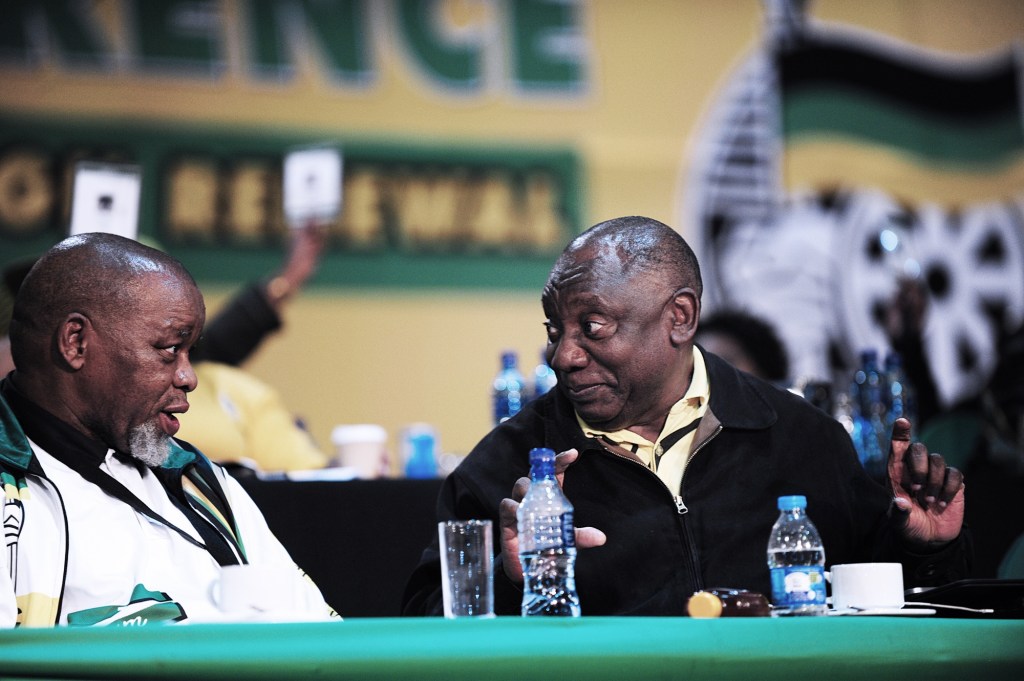
Are Ramaphosa and Mantashe enemies or brothers? Some thoughts on the value of public photography

11 August 2023

There are broadly two ideas concerning the relationship between Gwede Mantashe and Cyril Ramaphosa.

Some observers are keen to stress their closeness. They point to a shared history in the National Union of Mineworkers and extended personal interactions ever since.

Others argue that the two may have been close in the past, but that they are now at loggerheads over energy policy. In particular, Mantashe has been portrayed as a “coal fundamentalist”, and Ramaphosa as an enlightened renewables advocate.

Given the thespian capabilities of both men, I do not think evidence that they shout at each other in Union Building corridors can help us to judge the nature of their current relationship.

The fact that President Ramaphosa chose DME minister Mantashe for his current role — and not for any other — may suggest that Mantashe’s combative approach enjoys the tacit support of his principal.

In addition, photographs of the public interactions of politicians can be deeply illuminating. (Yes, I accept they can sometimes mislead.)

I think most of pictures of CR and GM suggest that the two men may fight, but that they are still brothers.

This judgement makes a significant difference to how government energy policy — and the future leadership dynamics of the ANC — should be interpreted.

Anthony

Compare …

Emerging tensions between the BRICS big players

ANTHONY BUTLER: Brics is on sandy India-China border soil

After suggestions that India’s Narendra Modi might only attend the August meeting virtually, India has now said Modi will be attending in person

First published in Business Day and BusinessLive

04 AUGUST 2023

While South Africans have been preoccupied with the theatrics of Russian President Vladimir Putin and his now-disembodied participation at the upcoming Brics (Brazil, Russia, India, China, SA) summit in Johannesburg, the real action has been taking place elsewhere.

In a foreign policy scare for SA earlier this week, the Hindustan Times suggested that Prime Minister Narendra Modi was considering only virtual participation in the August 22-24 meeting. After a reported phone conversation between Modi and President Cyril Ramaphosa on Thursday, the Indian government said that Modi would be attending in person after all.

The uncertainty about Modi’s plans was merely the latest manifestation of a deterioration in China-India relations that is likely to define the future direction of the Brics grouping.

Bric acronym inventor and former Goldman Sachs boss Jim O’Neill has lamented numerous disappointments with the grouping.

“Having created the Bric acronym to capture the collective potential of Brazil, Russia, India and China to influence the world economy”, he recently observed, “I now must ask a rather awkward question: When is that influence going to show up?”

Rather than collectively dominating the global economy by 2050, as O’Neill, in 2001, speculated might be possible, it is just two individual members, China and India, that have really grown. Between 2008 and 2021, China’s real GDP per capita rose almost 140% and India’s by 85%. Russia, Brazil and SA have essentially stagnated over this period.

As generators of resources for an insatiable Chinese economy, the three weaker members are in different ways deeply dependent on China for geopolitical influence and future economic prosperity. India, in contrast, is China’s potential future rival as an economic and political superpower.

Three issues are bringing incipient conflict between the two most populous Brics countries to the surface.

First, the border conflict between China and India has escalated. Clashes over the past three years along the countries’ 3,000km contested border have resulted in deepening militarisation and a hardening of positions in political systems legitimised by rabid nationalism.

Chinese expansionism

Second, India hopes to counter Chinese expansionism in the Indo-Pacific region. An Asian simulacrum of Nato, the Quadrilateral Security Dialogue (“Quad”) between India, Japan, Australia and the US, signals a deeper and wider rebalancing of India’s international relationships in favour of the US and its allies — and away from China.

Third, since 2020 China has pushed hesitant Brics partners to take concrete steps towards expansion, with this month’s summit in Sandton intended to set out criteria for the selection of new members — and perhaps even to indicate the likely candidates.

Like ostensible “de-dollarisation” proposals, this represents an optimistic or even romantic forward projection that anticipates a future role for Brics as an alternative locus of authority to Western-led institutions.

Given the current configuration of Brics, however, it is likely that the choice of candidate countries, and the immediate interests served by such an expansion, will be those of China and, to some degree, an otherwise embattled Russia.

India’s foreign policy establishment has been quite comfortable with Brics as a platform to showcase the country’s cherished and sentimental role as a nominal leader of the developing world. The candidate countries that China anticipates admitting in the enlargement process may well take Brics in a quite fresh geopolitical direction, one that runs directly counter to India’s longer-term interests.

When Brics leaders gather in person or virtually at the Sandton forum later this month, speculation will intensify about behind-the-scenes disagreements about expansion. Some observers already suspect a stalemate — or even the exercise of India’s effective veto powers.

Sceptics will claim that growing tensions between the two Brics countries with real or potential superpower status marks the beginning of the inevitable end for this once-promising international alliance.

• Butler teaches public policy at the University of Cape Town.
The many ways of hiding corruption

ANTHONY BUTLER: SA needs to wise up to ruses used to hide corrupt dealings

The country’s relatively sophisticated financial intelligence machinery and media are not enough

First published in Business Day and BusinessLive

21 JULY 2023

ANTHONY BUTLER

It is understandable that SA citizens struggle to muster much sympathy for the predicament of their national political leaders, but prominent ANC politicians really do confront a vexing challenge.

We are all familiar with the sad fact that leaders cannot rise in local or provincial political structures without judicious distribution of contracts, jobs and money. Unlike many other countries in the region, however, SA presents two major institutional obstacles to political ambition and the enjoyment of earthly comforts alike: a tenacious and well-organised investigative media and a relatively sophisticated financial intelligence machinery.

The Financial Intelligence Centre (FIC) Act obliges banks and businesses to report suspicious or unusual financial transactions, and the information gathered is channelled to investigative authorities, including the Asset Forfeiture Unit, the directorate for priority crime investigation and the Reserve Bank’s financial surveillance department.

Though the scale of monies recovered by these institutions is relatively modest, the reporting requirement is a significant deterrent and almost certainly encourages aspiring leaders to shift their activities to cash. There are reporting requirements on cash transactions above R50,000, but the FIC is overwhelmed with reports. Large cash movements tend not to be regarded as suspicious unless they are out of keeping with a transactor’s normal banking behaviour.

High-denomination notes can be used relatively safely to fund lavish lifestyles, pay for services rendered and fund internal party political campaigns. They may even be used for buying illegal surveillance equipment or for bribing delegates to amend their voting intentions.

We have caught fleeting glimpses of money at work across the decades: R500,000 in black plastic bags in the boot of union leader Willie Madisha’s car, former Madibeng municipal manager “Philly” Mapulane’s designation as “Mr Cash” as a result of allegations of cash-only kickbacks on local government tenders, or Zondo commission of inquiry testimony about bundles of R200 notes on the back seat of former finance minister Malusi Gigaba’s official limousine.

Illegal cigarette and alcohol distributors, or gangsters increasingly aligned with parties and party factions, presumably prefer cash. Given widespread claims of money bribes by familiar mining companies in other African countries, it would not be wild conjecture to imagine such behaviour in SA too.

Another advantage of cash is that it can cross borders. The ANC enjoys close “party to party” relationships with money-rich counterparts who have lax morals. Some friendly countries, such as the Russian Federation, have sometimes been accused of transferring large cash sums in diplomatic bags.

Cracking down on cash abuse is not easy. India’s “demonetisation” experiment in 2016 was designed to curtail the country’s huge shadow economy. It resulted instead in huge economic damage and probably failed to remove much “black money” from circulation.

Indian experience also shows that if cash becomes harder to deploy, wily politicians possess a wide range of alternative resource transfer options.

They can divert public funds to vibey digital communications consultancies that can assist them in their campaigns for leadership positions.

They can engage in what Indians call “Benami Transactions” — Benami being an Urdu word that means “without name”. In such cases, the beneficiary of a property purchase is not the person in whose name the property is purchased.

They may even use opaque transfer mechanisms, such as football player transfers or horse and cattle breeder sales, which allow large cash payments for items of objectively indeterminate value.

Citizens in SA will need to be alert to the use such widely known international ruses — and not just to bundles of banknotes in black plastic bags — if their efforts to curtail their leaders’ dubious financial stratagems are even partially to succeed.

• Butler teaches public policy at the University of Cape Town.
Just confused about just transition

ANTHONY BUTLER: The language of ‘just transition’ could become a Tower of Babel

Conflicting interests and interpretations have the potential to threaten the project itself

First published in Business Day and BusinessLive

07 JULY 2023

Delay and confusion continue to dog SA’s Just Energy Transition Partnership (JETP). The partnership, initially unveiled at COP26 in Glasgow in November 2021, brought SA together with EU partners, the US and the UK. Expected to provide $8.5bn in loan and grant funding, it was seen as the only mechanism on the table to source international finance to accelerate retirement of coal-fired power plants, reskill carbon sector workers and support coal-dependent regions. 

SA’s development partners viewed the JETP as a cost-effective way to reduce emissions while also encouraging private investment in clean energy, electrification and other green technologies. It was a test case to start filling a significant credibility gap in global energy transition policy, with agreements now being extended to other countries, including Indonesia, Vietnam, Egypt and India.

Some of the frustration that has emerged over the past two years no doubt results from the mixed messages emanating from different government ministers, Eskom and presidential advisory bodies about the future of coal generation and latterly about the content of the government’s Just Energy Transition Investment Plan. 

SA’s character as an open and vigorous democracy has facilitated an unexpectedly strong pushback against rapid decarbonisation. Businesses engaged in the extraction, brokering and trucking of coal are politically powerful and significant contributors to party funds.

While power cuts have negatively affected businesses across SA — notably in the key economic hubs of Gauteng and the Western Cape — the coal lobby is highly motivated and closely linked to leaders of the ANC in Mpumalanga.

The situation is complicated by the unintended consequences of BEE policy. Politicised BEE partnerships, when combined with the desire of established businesses to unburden themselves of toxic environmental legacies, have ensured that the most egregious despoilers of the environment in SA have the best political connections.

Meanwhile, unions such as the National Union of Mineworkers (NUM) fear green jobs will be taken by non-unionised labour, a position reflected in the prominent role granted to the union’s former general secretary, energy minister Gwede Mantashe.

Beyond these SA-specific factors, fundamental differences about the meaning of “just transition” have been exposed, and these threaten transition plans around the world. 

First, in much of Europe — and among what Mantashe characterises as “foreign funded” environmental NGOs — just transition is linked to the classical idea of “sustainable development”: the need to meet the needs of the present generation without unfairly compromising the ability of future generations to meet their own needs. The new carbon border adjustment mechanism and other measures testify to the growing determination of the EU with regard to generational fairness.

In SA, this notion has been overshadowed by a second, labour-orientated conception of just transition that first emerged in US labour unions in the 1970s. This built on the early idea that a transition “superfund” should be created to provide for affected worker retraining and community support. 

A third prominent “justice” theme, also important in SA, concerns energy poverty, given that a majority of citizens lack electricity that is both accessible and affordable. This obliges too many communities to rely on health-destroying and dangerous household energy sources.

Finally, justice also has a financing dimension, with many of SA’s partners in the Global South emphasising that early industrialisers in the West must pay for just transition and compensate those most affected by climate change. President Cyril Ramaphosa dramatises the scale of necessary transition investments for SA alone at almost $100bn over the next decade.

During international negotiations, a lack of conceptual clarity is sometimes politically expedient. There is a danger, however, that the idea of “just transition” has so many contested and contradictory meanings that frustration and miscommunication will eventually mutate into distrust and intransigence.

• Butler teaches public policy at the University of Cape Town

Little progress on NHI

ANTHONY BUTLER: The anxiety about our version of NHI is justified

First published in Business Day and BusinessLive

 BL PREMIUM

23 JUNE 2023

Health system reform is both necessary and possible. As The Economist magazine noted in 2018, “universal healthcare, worldwide, is within reach: the case for it is a powerful one — including in poor countries”.  

Poorly run and exclusionary health systems undermine education, discourage entrepreneurship, reduce worker productivity and slow economic growth. As a result of sensible reforms, middle-income countries such as Thailand, Chile and Costa Rica now enjoy health outcomes similar to those of high-income states. 

We know private care is no long-term solution even for its beneficiaries. Information asymmetries in the health sector mean we do not know what treatment will benefit us, and the incentives confronting treatment providers result inexorably in waste, spiralling healthcare costs and higher premiums.  

However, despite the imperative and potential benefits of reform, there is little relief to be found in the National Health Insurance (NHI)  bill that has finally concluded its tortuous journey through parliament’s legislative process. This is a deeply disappointing product for a decade or more of deliberation. 

We should remember that the legislation does little to nothing to tackle the key determinants of SA’s poor health outcomes. It will not divert resources from ineffectual treatment programmes towards prevention and health-building initiatives. It will not dent growing obesity, cardiovascular disease and poor nutrition. It will not improve an education system that denies young people the knowledge they require to look after their own health and that of their children. 

It will not bring the affordable electricity that is needed to end indoor coal and wood burning, and it will not resolve the epidemics of HIV/Aids and drug-resistant tuberculosis, reduce the toll of traffic accidents, or prevent violent deaths attributable to alcohol. In addition, it will not create social support systems to reduce the burden placed by the old and vulnerable on expensive health facilities. 

Moreover, basic and appalling problems of mismanagement and corruption in the public health system will not be health with by an NHI. Indeed, even many strong proponents of an NHI have noted that the proposed reforms are likely to invite further corruption. 

Worse still, the NHI bill falls short of our most basic expectations of credible planning. First, it does not set out, even in broad terms, an implementation plan. How do we get from where we are today to where parliament intends we should be tomorrow?  

Second, this is a financing scheme but it does not seem to be based on any credible plan for sourcing the revenues required for enormous new recurrent expenditures. 

Third, SA discovered in the earlier years of the HIV/Aids pandemic that the key constraints on health system intervention are human rather than financial resources. The NHI proposes breath-taking changes in the organisation and everyday activities of health sector workers. Yet there is no credible strategy for securing support — or even acquiescence — from the extremely mobile health professionals on which the system will depend. 

On the government side there has been much tedious self-righteousness, and a failure to accept that its own credibility has been lost. The ANC can scarcely complain when its promises about NHI are greeted with incredulity. This has been made worse by the implication that those who oppose the current bill are simply heartless.  

Opponents of NHI sometimes appear selfish and uncaring, but they are mostly motivated by anxiety — and it is perfectly understandable to be scared of dysfunctional public hospitals and clinics. Moreover, such fears are evident across the middle class, black and white. This stubborn political fact will probably ultimately defeat the wearyingly dogmatic champions of the current iteration of NHI.

Hopefully, there is still time and space to return to more productive deliberation about how to realise the potential gains universal access can bring. 

• Butler teaches public policy at the University of Cape Town.

Holden’s take on Zondo

ANTHONY BUTLER: A handy round-up of Zondo’s damning findings

First published in Business Day and BusinessLive

09 JUNE 2023

Paul Holden’s handy new book, Zondo at Your Fingertips, provides a much-needed wake-up call to SA’s disgruntled but exhausted citizens.

As Holden observes, the Zondo state capture inquiry was a mammoth and historic enterprise, comprising 75,000 pages of transcripts, 1.7-million pages of documentary evidence and 19 volumes of findings stretching to an astounding 4,750 pages. According to Holden, we now face the “potential tragedy” that the commission’s reports will remain largely unread and ignored. 

Holden is broadly impressed by an inquiry he describes as “the real deal”. Critics of a model that is deployed in most Commonwealth countries, this columnist included, may initially counter that Holden is perpetuating the misconception that commissions are actually meant to uncover the truth. 

In reality, claim the naysayers, formal commissions are often used by governments to evade responsibility for unpopular decisions, for example about the location of unwelcome airports or nuclear power plants. Meanwhile, an inquiry into a terrible event, such as a massacre of striking mineworkers by the police, can move so slowly that guilty parties can co-ordinate their excuses and public outrage can subside. 

Findings are typically couched in legal jargon and published in multiple volumes so vast that they are in effect inaccessible. The judges who chair such investigations can be quite good at setting out some of what actually happened in some detail. But they rarely pin down the culpability of particular individuals and they are poorly equipped to make policy recommendations about how to prevent a recurrence. 

But Holden is no innocent. He testified at the Seriti commission of inquiry into arms deal corruption and describes the farrago of nonsense that now retired judge Willie Seriti birthed — a report set aside by the high court in 2019 — as a “shameful whitewash”.  

He is also critical of many aspects of judge Raymond Zondo’s report: the highly uneven quality of its forensic analysis; its kid-glove handling of multinational corporations and enablers such as big auditing companies; its inability to place state capture in its international context; and its failure to interrogate the SA banks that turned a blind eye to unmissable money laundering.  

Despite these flaws, Holden insists Zondo has performed a great service for SA by “digging deep” into the facts, establishing widely accepted realities in the face of disinformation exercises, and flagging the political dimension of state capture, including ANC culpability. 

Holden’s real usefulness is that he casts a highly sceptical eye over Zondo’s recommendations while insisting SA society must engage with and improve upon them. 

His readable synthesis reduces Zondo’s wordy recommendation volume to a series of clearly specified problems: a fragile procurement system; the collapse of state-owned enterprise (SOE) governance; the negative effects of party political funding; the vulnerability of whistleblowers; and multiple failures of oversight mechanisms. 

Zondo’s proposed remedies are a mixed bag indeed. Some are plausible, such as a new institutional architecture for procurement, including professional procurement officers and proper whistleblower protection, and an oversight committee for SOE board appointments. Others, such as a “charter against corruption” and the criminalisation of donations given in expectation of contracts, are merely hot air.

A few of Zondo’s ideas, such as deferred prosecution agreements that allow companies to treat illegal activity as a business expense, or his poorly informed ruminations on SA’s electoral system, are at best half-baked. 

Holden’s purpose is not to glorify Zondo or insist on the implementation of his various recommendations. Rather he is intensely alert to the problem that the commission of inquiry model does not incorporate any implementation machinery.

It is up to political organisations and citizens to take stock of the enormous resource that Zondo has provided and to interrogate and then push forward the credible intervention opportunities. 

• Butler teaches public policy at the University of Cape Town.
Gloomy sentiments

ANTHONY BUTLER: Things can get worse in SA — and fast

Sense of foreboding in the country is spreading to international partners and investors

First published in Business Day and BusinessLive

26 MAY 2023

Earlier this week ANC secretary-general Fikile Mbalula blithely reassured a BBC interviewer that “if certain things are not resolved we will become a failed state, but we are not journeying towards that direction”.

Unfortunately, Mbalula did not reveal what those “certain things” are, or how exactly they will be tackled. 

In the past, limitations of public healthcare, security and education did not unduly trouble local elites. Today, in contrast, a deep sense of apprehension has set in, with widespread fear about a total electricity blackout or the nightmare of a failed state. The new and alarming sense of foreboding that has gripped much of SA’s commercial and intellectual leadership is understandably spreading to international partners and investors. 

There is an inexorable accumulation of institutions and organisations that just don’t work. Power cuts are escalating, and a parallel collapse of local electricity distribution infrastructure is unfolding. The appalling cholera outbreak in Hammanskraal feels like the harbinger of a new epoch in the history of SA’s public health. 

The things that do not work cannot be fixed because other things are broken. The dysfunction of the freight rail system has driven heavy lorries onto a road system that is consequently collapsing too. Eskom is not just destroying itself: it is collapsing water purification and sewage plants, basic public health and education systems, and undermining the viability of businesses, big and small. The longstanding psychological escape valve of “hope for the future” has progressively closed. 

Three realities cannot be gainsaid. First, the idea that the governing party can reform itself is no longer credible. The new generation of leaders elected to the national executive committee in 2022 is more provincial, poorly educated, dogmatic and corrupt than any of its predecessors. No matter how demonstrably “deployment” has wrecked parastatal performance — most pertinently at Eskom — the ANC will not abandon it.  

Second, the party will not easily be removed through the ballot box. It will continue to campaign well, fuelled by money from parastatals, corruption, and international party-to-party transfers. The danger of ballot rigging is real. If the party nonetheless loses, it will most probably still run SA’s national government by informal coalition. The worse it performs, the more likely it is to team up with the EFF, a development that will make matters even worse. 

Third, even if the ANC loses power, democracy turns on the idea that a fresh coalition can form a new government and steer the machinery of the state in a different direction. However, the ship of state the ANC will leave behind has been holed below the waterline. Events in Tshwane over the past few days have dramatised this predicament.

The fiscus is weakened — both locally and nationally — which means there is no money for a fresh government to respond to inherited crises. Human resources in the public sector are in a parlous condition across almost all areas of its activity. Worse still, the removal of the ANC from political office at local, provincial and national levels will not dismantle networks of corruption that are now entrenched almost everywhere. 

The progressive deterioration of the state will continue. The ANC will not change. Electoral politics will not make much difference. Taken together, these features of our situation will accelerate the general and dramatic loss of hope domestically in the future of the country, which means money and skills will leave even faster.  

As for the blocs and countries whose companies actually invest in SA — in descending order the EU, US and UK — they will take their cue from domestic sentiment. While the situation is obviously bad, there is no reason to believe it cannot get far worse quite quickly. 

• Butler teaches public policy at the University of Cape Town.

Closing in on a grid collapse

ANTHONY BUTLER: Eskom’s handling of power cuts proves to be exceptional

Exemptions from load-shedding are often deemed impractical, except when it comes to ANC shindigs

First published in BusinessLive and Business Day

12 MAY 2023

Though a total failure of SA’s electricity system is relatively unlikely, it remains a matter of great concern. A grid collapse would shut down water and sewage treatment plants, telephone and internet services, payment systems and food supply chains. It would also be likely to bring looting and unrest.  

The fact that demand for electricity exceeds the capacity of the power grid increases the possibility of a total system collapse as a result of a cascading grid failure. Yet we still do not have a coherent policy response from the central government departments charged with responsibility for energy planning and the oversight of Eskom. 

Resources have been diverted away from the regular inspection and upgrading of power lines, transformers, substations and other critical components. Deliberate acts of sabotage and vandalism, motivated by financial gain, have been targeted at power infrastructure.  

Last week the judiciary made matters worse. Despite concerns about practicality, the high court in Pretoria ordered the public enterprises minister to take “all reasonable steps within 60 days” to stabilise electricity supply to schools, hospitals and police stations. Though the minister is appealing against the judgment, higher courts may confirm that constitutional rights to healthcare, education and justice impose just such obligations. 

Former Eskom CEO André de Ruyter pertinently warned the court that, with so many such facilities being embedded in distribution networks around the country, “were they to be excluded from load-shedding there would be very little load left to shed to reduce demand on the grid”, so presenting “a manifest risk of grid collapse or blackout”. 

New challenges concern the politicisation of grid system management. First, we have a growing problem of political exemptions from load-shedding. The ANC’s Nasrec conference in December 2022 was memorably exempted from power cuts by Johannesburg’s City Power, despite Nasrec being equipped with standby generators. ANC leaders presumably wanted to avoid the embarrassment of generators kicking in while proceedings were under way. 

Energy expert Chris Yelland has reported that the tiny seaside town of Port Alfred in the Eastern Cape has been exempted from power cuts this week because it is hosting a workshop on labour policy for delegates from the Brics (Brazil, Russia, India, China and SA) group of countries. The exemption was requested by the department of labour and granted by Eskom’s head office. Such an exemption is apparently illegal under the Electricity Regulation Act and it was not notified to the system operator at Eskom National Control, which is the only body authorised to allow exemptions from load-shedding. 

Since the Port Alfred venue had generators available, the key motivation, once again, would appear to be the ANC wanting to avoid embarrassment. If such exemptions proliferate the grounds for preferential and inequitable treatment will also grow, along with greater risks to the stability of the grid.  

A second key dimension of politicisation concerns party politics. We can anticipate every effort will be made to suspend load-shedding for the longest possible period in advance of the 2024  national and provincial elections, no matter what costs and system risks this might bring.  

Meanwhile, Cape Town and the Western Cape are moving ahead with initiatives to end load-shedding, using hydropower and solar generation, energy storage, buybacks from households and businesses, and voluntary energy savings. If the gulf between load-shedding experience in the Cape and the rest of the country grows, so too will the temptation to meddle in electricity system management. Any loss of trust and effective co-ordination between government entities presents a further risk factor. 

SA will become increasingly dependent on “automatic” grid protection systems that use fault detectors, relays and protective circuit breakers to identify and isolate faults, so preventing them from spreading and causing cascading failures. Such systems are themselves far from being fail-safe. 

• Butler teaches public policy at the University of Cape Town.

The unlikely rise of the Gauteng ANC

ANTHONY BUTLER: For now, the Gauteng tail keeps wagging the ANC dog

The top leadership has been noticeably centred on the province since the Zuma presidency

First published in BusinessLive and Business Day

28 APRIL 2023 – 05:00

Something unexpected may be happening in the ANC leadership. The conventional wisdom among political analysts is that the governing party is undergoing a long-term divergence between party mechanisms of leadership selection and policy determination on the one hand, and the dynamics of the wider society on the other. 

SA has been urbanising rapidly, and in consequence, has become more preoccupied with the problems of city dwellers. However, the ANC remains dominated by branch and regional networks in mainly rural areas and slow population-growth provinces such as KwaZulu-Natal, the Eastern Cape and Limpopo. 

Strangely, though, the ANC’s topmost leadership has become noticeably Gauteng-centred since the much lamented departure of lamentable former president Jacob Zuma. Consider the composition of the “Top Seven” of the former liberation movement, headed by Gauteng-born and raised ANC president Cyril Ramaphosa.

His deputy, Paul Mashatile, is a former Gauteng overlord. Most of the rest of the Top Seven are members of the “Mashatile faction” or the “Gauteng faction”, or both, and seem set on replacing the province’s Ramaphosa with the province’s Mashatile when the time comes (or perhaps before). 

This problem of Gauteng arrogance was exemplified by the national executive committee (NEC) statement on coalition government this week. The December ANC national conference directed the NEC to develop a strategic perspective on coalition government, a task that was assigned to former Gauteng chair and premier David Makhura.  

According to his detractors, Makhura exemplifies a time-honoured ANC tactic of donning thick-lensed spectacles in the hope of being taken for an honest intellectual. His task on this occasion was not hard, though, because he could simply lift ideas from a book on coalition government, Coalitions of Inconvenience, published in 2021 by an excellent Gauteng think-tank, the Mapungubwe Institute for Strategic Reflection. 

Makhura came up with a reasonable set of proposals to reduce instability in local government coalitions, including a common minimum programme that would be made public, and some attempt to find ideological and policy commonalities.  

Although the report is nominally about municipal coalitions, ANC secretary-general Fikile Mbalula, who takes himself more seriously than anybody else since his election to the position, made it clear that the coming general election is his real priority. 

There is no chance of the ANC securing constitutional adaptations needed to introduce formal changes in the process of forming national or provincial governments, such as mandatory submission of a formal coalition or confidence-and-supply agreement. But it could certainly regulate the way in which the party’s own provincial and local structures approach coalition agreements. 

Yet the ostensible grounds provided for a new coalition policy comprise mostly debacles of metro coalition government that the Gauteng ANC — and its local EFF buddies — have themselves created, many would say deliberately. Nobody seriously believes feeble mayors installed in Ekurhuleni, the West Rand or Johannesburg were meant to succeed. Instead, the deals struck have been great for the two parties in the province, which have been free to share the spoils of government behind the backs of the various feckless mayors they have elevated. 

The EFF is leveraging its power in Gauteng — where the provincial ANC needs its help to survive in office — to secure access to position, power and resources in national government. Worse still, Mbalula now insists that the Gauteng-skewed leadership impose its dictates about coalition partnerships on other provinces. Even ANC behemoths such as the Eastern Cape and KwaZulu-Natal, which have many more delegates than Gauteng and view the EFF as a mere irritant, will be forced to obey national (meaning Gauteng) dictates.

This then is the puzzle. How long can the Gauteng tail continue to wag the ANC dog? 

• Butler teaches public policy at the University of Cape Town.