
Time to end cadre deployment
ANTHONY BUTLER: At best, cadre deployment was a transitional instrument whose time has passed
It might be a good idea in principle but it has been a disaster in practice
First published in BL PREMIUM
29 APRIL 2021
President Cyril Ramaphosa was unfortunately ambivalent about cadre deployment at his appearance before the Zondo commission of inquiry this week. He argued that deployment “cannot be faulted in principle”, while conceding that there are “weaknesses in its practical implementation”.
He is surely right that politicisation is unavoidable and in respects desirable. Public servants cannot help but bring values, intellectual assumptions and personal networks to their roles. In addition, a democratic system requires a public service that is responsive to the policy preferences of a properly elected government.
If cadre deployment is a good idea in principle, however, there is no escaping that it has been a disaster in practice. Drawing selectively on the findings of an Organisation for Economic Co-operation and Development study, Ramaphosa ignored conclusive evidence from the same body that unchecked conflicts of interest, and a lack of transparency in appointments, deeply damage the operations of the state.
Public service & administration minister Senzo Mchunu this week told a conference of the government and public policy think-tank that public perceptions of incompetence, poor productivity, lethargy and unprofessional conduct are “not wrong”. More than a third of civil servants occupy positions they are demonstrably not qualified for.
Meanwhile, the boards of state-owned enterprises (SOEs) and government agencies have been stuffed with an array of disreputable deployees, from Brian Molefe to Dudu Myeni and Arthur Fraser. Ramaphosa conceded to the commission of inquiry that disastrous appointments have been made, but he suggested this was not a result of the deployment process. In fact responsibility lies with Jacob Zuma, who purportedly circumvented the deployment committee of which Ramaphosa was the chair.
There is surely a deeper problem with deployment that needs to be confronted honestly. The policy was always designed to do more than help overhaul the apartheid state. Underlying it was a pseudo-Marxist assumption that a “capitalist state” is predisposed to service the interests of the owners of capital. It is therefore a hostile terrain that must be occupied, an instrument whose “levers of power” must be “seized”.
The ANC also belittled the institutions of “bourgeois democracy” — parliament, the media, civil society organisations and mechanisms of intrastate accountability — that are in fact essential if corruption is to be contained. The ANC’s ambivalence about stable protections for public service impartiality created space for cycles to build up between deployment, access to state resources and donations to the party or its factions.
Meanwhile, a party fundraiser, Valli Moosa, was deployed in the mid-2000s to chair Eskom, at exactly the moment an ANC-aligned investment vehicle, Chancellor House, secured enormous remunerative contracts from the parastatal. This helped make legitimate what soon became a systematic looting of SOEs.
Money flows and deployments have become systemically linked, and donations have become de facto kickbacks. This system has matured, and its reach has extended beyond tender and audit committees to embrace external auditors and intrastate accountability mechanisms.
Surely it is time for deployment to be retired as a philosophy and as a practice. At best, it was a transitional instrument whose rationale and time have passed. Ramaphosa’s position, however, is to hedge. He has promised to establish an “SOE council”, which will supposedly improve governance and oversee appointment processes.
The Public Service Commission (PSC) will be empowered to play a new role in the appointment of senior national and provincial officials. There is also talk of a new head of the public service to oversee bureaucrats’ career progression in a “professionalised” state.
This raises one obvious question: how can we be sure the new parastatal council, the enhanced PSC, and the fresh civil service head, will perform their roles in a principled way? Don’t worry, is Ramaphosa’s answer. The deployment committee will see to it that in all three cases the best people for the job will be appointed.
• Butler teaches public policy at the University of Cape Town.
Unshackle Gauteng and the Western Cape so that they can grow
ANTHONY BUTLER: Many fantasies about changing SA’s provincial layout
BL PREMIUM 15 APRIL 2021
ANTHONY BUTLER
SA is a unitary state rather than a federation. We elect provincial parliaments with great solemnity, and blue light convoys choke the streets of our provincial capitals, but provinces do not much pass laws, levy taxes or control their own budgets. Policy is made at the centre and provinces are hooked up to a drip-feed of national resources.
Fantasies circulate about how this might change. Well-meaning development specialists say we can abolish provinces altogether. Secessionists say provinces can simply opt out of the republic. A larger group of dreamers in the ANC yearn for the day when “certain provinces” can be merged with their neighbours.
None of this will happen, because vast vested interests are now embedded in our system of provincial government. The provinces have also effectively accommodated the cultural and ethnic peculiarities of different regions within a single system of government.
The trouble is that this system is a brake on economic development. All nine provinces are run in accordance with a single legislative and regulatory template, designed primarily to save the weaker provinces from collapse.
Meanwhile, two provinces, Gauteng and Western Cape, contribute half of national GDP and host half of registered income taxpayers. They enjoy younger and better educated populations and deliver public services with greater effect.
It is not polite to say so, but seven of the provinces are poorly run, in part because of their historical legacies, such as the former bantustans. The slowest hold back the fastest in all societies.
Some countries have resorted to “asymmetric federalism”, in which the constituent units of a federation enjoy different powers, in line with their capabilities and needs. Unitary systems such as ours can implement asymmetrical devolution, in which variable powers are delegated by the national government to particular provinces and cities on a qualified and reversible basis.
SA’s Brics partners China, India, and Russia have asymmetric mechanisms. China’s provinces, autonomous regions and special administrative regions have functions tailored to their practical developmental needs, as well as to their political circumstances. India, for its part, has experimented for decades with unique arrangements for subnational regions.
Speaking at the Cape Town Press Club this week, Western Cape premier Alan Winde argued that we need greater provincial powers in SA. He noted that his province has similar needs and challenges to Gauteng’s.
These two provinces have already forged ahead in the implementation of health and education policies, and in fields such as investment promotion. When it comes to housing, the government is using forms of conditionality that empower capable municipalities to take greater control.
Meanwhile, the Covid-19 crisis has shown that fast-growing and innovative provinces can bring benefits to their neighbours. Gauteng and the Western Cape, however, both need fresh powers to create integrated transport systems out of today’s multilevel chaos.
While there are serious risks that provincial police services would be captured by shady politicians, provinces that can run their own law-and-order systems effectively should not be stopped from doing so.
In the energy and broader infrastructure sectors, national governance frameworks appropriate to the coal economy of the 20th century need to be updated for the technologies of a more decentralised world.
Some caution is in order: the special powers delegated to the Basque and Catalan regions of Spain, for example, or to Scotland in the UK, have solved problems but created others. Self-government can easily tip into ethnic separatism.
Moreover, a fresh intergovernmental contract would have to accompany asymmetric devolution in SA. The gains to autonomous and fast-growing provinces would need to be transparently shared with their less advantaged counterparts.
• Butler teaches public policy at the University of Cape Town.
Getting off the ground
ANTHONY BUTLER: Shooting for the moon is a pie in the sky goal for SA politics
Desperate governments tend to hire advisers who will tell them what they want to hear, and Mariana Mazzucato has our government’s ear
First published in BusinessLive
2 APRIL 2021
We all agree that the presidential economic advisory council shouldn’t just be a talking shop. It is less clear whether it should directly challenge the conventional assumptions of the president and his ministers, or instead accept — and merely refine — the prevailing ideas of those in power.
Cynics have long embraced a general rule about the role of ideas in political life. Politicians do not dispassionately seek out the truth or, indeed, consistently recall that such a concept exists. Instead, they search for theories — and academic advisers — that tell them what they want to hear.
In this way their politically convenient programmes can be presented as the outcomes of a process of principled reasoning, purportedly built on robust intellectual foundations.
A president suffering from fiscal incontinence — perhaps because unions and special interest groups are breathing down his neck — can recruit a modern monetary theorist to explain why his actions are justified. Advisers to a desperate government that wants to crank up the banknote printing presses can seek out intellectual justifications for revoking central bank independence.
The most high profile international member of the presidential economic advisory council, Prof Mariana Mazzucato, founding director of an institute for innovation at University College London, provides an interesting test case for this theory about the role of ideas.
Some warning signs accompanied Mazzucato’s recruitment. Apparently, public enterprises minister Pravin Gordhan sought her out after reading her well-regarded book on the “entrepreneurial state”. Ominously, her ideas also struck a chord with trade, industry and competition minister Ebrahim Patel. Introduced to President Cyril Ramaphosa at a Davos dinner, she was apparently penciled in there and then for an advisory council role.
Unsurprisingly, such a recruitment methodology can entrench the familiar pathology of politicians being told only what they want to hear. There may be a Mazzucato effect, in addition, which magnifies her influence: her arguments are extremely well-organised, and they are unusually powerfully expressed.
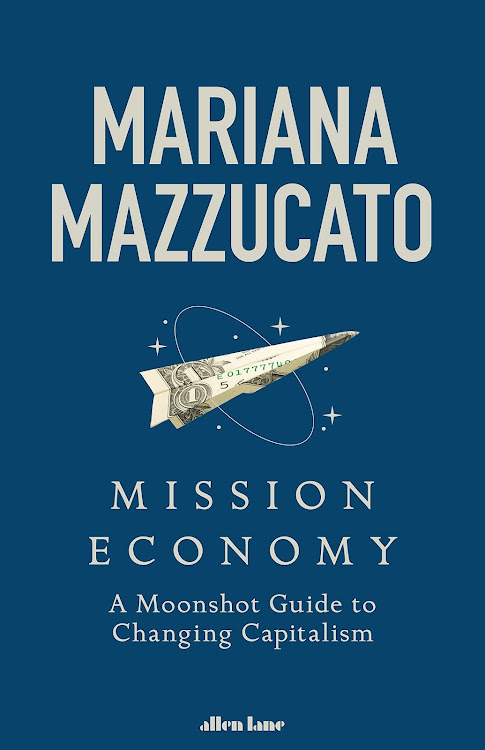
In a recently published book, Mission Economy: A Moonshot Guide to Changing Capitalism, she revisits her earlier claims about state-led innovation in the post-war US. But this is also a more ambitious effort “to rethink capitalism through rethinking the state”, which captures some of the anti-capitalist spirit of the times.
She points to the role of the state in driving “game-changing” breakthroughs in technology-based businesses, highlighting the dependence of companies such as Apple on prior state-funded research, in the internet, programming languages, and voice-activated systems, among many others. Google’s search algorithm and the most profitable modern medicines alike, she shows, grew out of state-funded projects.
Mazzucato methodically debunks a myth prevalent in the US, and other parts of the global Anglosphere, that the private sector is good and the public bad. She also powerfully condemns the way risk has been socialised by the state while rewards have been privatised by tax-dodging beneficiary corporations.
Her signature theme is that the state should organise its interventions around “grand challenges”. For her, the 1960s Apollo programme is the archetypal “moonshot”, an inspirational mission that created not just new technologies but also new markets and new human possibilities.
Today’s grand challenges include climate change, the amelioration of global poverty, gender inequality, hunger, and deficiencies in the provision of basic education and health. Mazzucato concedes that these goals are “even more challenging than the moon landing”. This is something of an understatement. But her insistence that these challenges require concerted action is important and undeniable.
Mazzucato’s selection bias, however, represents a serious flaw of method, one she shares with “developmental state” proponents: she cherry-picks state-driven interventions that “worked” and ignores similar interventions that didn’t. (Those who believe the moon landings were a colossal waste of time and resources, driven by mindless superpower rivalry, are not entertained at all.)
She does not reflect on the failures, such as the 1970s US war on cancer, designed precisely to replicate the alleged successes of Apollo, let alone the myriad disastrous developmental state interventions that scarred many economies, north and south, across the post-war period.
Giving politicians leeway to engage in “moonshot” programmes has often been an invitation for them to spread patronage and secure short term political advantage. Today’s “strongman” leaders, in particular, are enamoured of visionary initiatives, or great leaps forward that embody national virility and symbolise the leader’s position at the vanguard of change.
SA has had its own recent moonshots. For the Fifa Soccer World Cup in 2010, for example, routine state activities such as maintaining energy and communications infrastructure were suspended, while resources were poured into infrastructural white elephants. The event was essentially a nationalist political project, so satisfying to elites that they have been unable to account frankly for dismal balance of costs of benefits it generated.
Former president Jacob Zuma’s proposed Russian nuclear procurement exercise was perhaps another great mission, one that was tragically derailed by counter-revolutionary forces.
In the US, where scepticism about the state is deeply entrenched and acclaim for entrepreneurial genius is naïve and fanciful, Mazzucato no doubt provides a useful corrective to prevailing wisdom, especially among conventional academic economists.
In SA, a “moonshot mentality” is likely to be less benign, liable instead to entrench the reactionary mindsets of some economy cluster ministers, and to embolden them in their many ill-considered interventions.
Privatising SA’s state-owned enterprises, Mazzucato has claimed, will “deprive the state … of an important pool of technical competencies in strategic sectors”. But SAA is not going to the moon. It can’t even get off the ground.
• Butler teaches public policy at the University of Cape Town.
Mantashe is in the wrong job
ANTHONY BUTLER: Good ol’ Gwede, an asset to the president, a liability to his portfolio
The energy minister is too invested in coal mining to make the drastic changes needed for stable electricity
First published in BD and BDLive
18 MARCH 2021
What distinguishes finance minister Tito Mboweni from mineral resources & energy minister Gwede Mantashe? (No, not that, Tigers. Don’t even go there.)
The pertinent contrast is that Mboweni is mostly blamed for his own decisions. Mantashe, meanwhile, is largely viewed as a proxy for President Cyril Ramaphosa.
Why is Mantashe seen as Ramaphosa’s man? He worked in the mining industry from the age of 20, and ascended quickly in the National Union of Mineworkers (NUM) created by Ramaphosa. He rose to national prominence at the watershed Polokwane conference of the ANC in 2007, where he was elected secretary-general of the party.
Mantashe was key to Ramaphosa’s rise to the deputy presidency of the ANC in 2012. Lobbied to join the anti-Jacob Zuma slate at Mangaung, he stuck with the incumbent but used his leverage to advance Ramaphosa’s candidacy.
As party manager in the run-up to the 2017 Nasrec conference Mantashe helped make possible Ramaphosa’s triumph. He also averted an attempt to collapse the conference before its conclusion. At Ramaphosa’s birthday party in November 2017, just a month before the conference, Mantashe was at the aspirant president’s side.
Mantashe seemed an inspired choice as minister responsible for energy policy. But he was quickly bogged down in yesterday’s political challenges, rather than realising today’s technological opportunities.
The Eskom coal supply chain, and the associated trucking industry, offers a roll-call of influential ANC donors. Many of these entrepreneurs are at the centre of the historic process of building a significant black business class in SA. Meanwhile, as deputy president David Mabuza noted in parliament last week, the Eskom workforce has doubled in a decade, while key skills have been lost.
The ANC as a whole is implicated in these dynamics, not least because the disastrous R450bn Medupi and Kusile projects were subverted from their start — in the Thabo Mbeki era — to fund the party and ANC-linked beneficiaries.
A reforming ANC energy minister therefore comes under fire from all sides. This week the NUM condemned proposals to trim the Eskom workforce by a mere 4,000 — and this in the middle of an unprecedented economic crisis.
Little wonder Mantashe has sometimes grasped at the illusory straw of “clean coal” and averted hard decisions about regulatory reform. While he delays, however, unreliable and costly electricity is painfully reducing investment and jobs. And things will get worse fast.
The coal dependency of the energy economy will make it increasingly hard to service the government’s burgeoning debt, because international bond investors are looking to reduce the carbon intensity of their portfolios. Carbon-linked barriers to exports will follow, not least for the automotive industry.
Meanwhile, in the absence of a managed domestic energy transition we will soon have a stampede. Big cities, big businesses and the wealthy households that cross-subsidise municipal services are starting to migrate off-grid.
Rather than exploiting the financial opportunities presented by the uptake of new technologies, Mantashe resembles the King Canute of energy: an old man trying to hold back the tides. The minister responsible for stabilising Eskom and managing the energy transition needs to be forward-looking rather than a prisoner of the past.
Inexorable change will leave behind casualties, to be sure, among them emerging business people, the coal lobby, elements of organised labour and key party donors. But so long as the minister is seen as Ramaphosa’s proxy, the pain that flows from policy and regulatory change will be laid at the president’s door.
Perhaps one Mboweni is enough for any government, but an energy reform champion who takes responsibility for his own decisions is sorely needed. Mantashe needs a fresh portfolio in which his talents and his proximity to the president represent an asset rather than a liability.
• Butler teaches public policy at the University of Cape Town.
Burdens of academic leadership
Spare a thought for the rich and powerful. First published in Business Day, 12 April, 2013.
South African newspapers endlessly lament the travails of the poor. But the burdens under which productive members of society labour merits few column inches. Take the present clamour for self-defeating tax increases. Beyond the moral truism that citizens are entitled to the fruits of their own labour, tax rises deter investment, slow growth and so reduce overall tax receipts.
Although the poor should be incentivised to search for work, the government refuses to dismantle debilitating welfare systems — and it is the rich who have to pay for them. Those who have entrepreneurial drive are meanwhile criticised for using incentives to make themselves work harder.
Businessmen on remuneration committees have even been condemned for rewarding the engineers of growth: themselves. Black businesspeople shoulder even more onerous duties. They are obliged to become rich in the national interest in order to create a “patriotic bourgeoisie”.
In the public sector, the powerful face similar challenges. Higher Education Minister Blade Nzimande has been forced to relinquish his proletarian lifestyle and to accept the unwelcome trappings of state office. One former trade union leader, Zwelinzima Vavi, this week blamed Nzimande for his ministerial predicament. Before his recent retirement, however, Vavi was himself the beneficiary of generous trade union remuneration policies.
In the past, the academic community has remained above, or perhaps below, the neoliberal system (albeit not altogether voluntarily). Members of Wits University’s so-called “Parkview proletariat”, for example, have for decades generated knowledge of incalculable value before retiring to humble dwellings at the end of the working day, or indeed earlier. Wits’s new vice-chancellor, Adam Habib, exemplifies such selflessness and argues that “empathy for the poor should be part of our humanity” — a remark that recalls former US president George Bush’s observation that he “knows how hard it is for you to put food on your family”.
Today, however, the obligation to allocate scarce skills in the interests of the nation has forced senior academics in “formerly Afrikaans” universities to create large consulting companies to deliver services to the state.
In the formerly liberal universities, at least, “academic freedom” still reigns supreme. English-speaking scholars, unlike their Afrikaner counterparts, refuse to bow down to public authority or to act voluntarily as instruments of the state: they have to be paid to do this. Despite these underlying differences in philosophy, therefore, the outcome is much the same: some academics are compelled in the national interest to accept additional remuneration that they do not want.
Now Habib has become embroiled in a controversy about proposed renovations to his official residence, Savernake. This Randlord’s palace, owned by the Price Family Trust, has been made available to Wits on the understanding that the university will maintain it. The agreement stipulates that the mansion will revert to the trust if the vice-chancellor does not reside there. “This,” Habib has explained, “is why Wits has insisted in my case, and all others before me, that the vice-chancellor lives in the residence.”
Inconveniently, the mansion is a “heritage house” (the cultural equivalent of a National Key Point) and it therefore cannot be equipped with Wits office furniture and blue carpet tiles by the university maintenance department. Just as the government has paid for “security upgrades” at Nkandla, so Wits must now pay more than R10m to renovate Savernake, and all this to imprison the unfortunate vice-chancellor in a vulgar bourgeois environment that he abhors.
Taxes. Virtual imprisonment. Victimisation of the rich and powerful. When will it all end? The fad of democracy has made it all but impossible for the rich to speak out. As former US vice-president Dan Quayle once observed of his own right-thinking but increasingly unpopular party: “Republicans have been accused of abandoning the poor. It’s the other way around. They never vote for us.”
- Butler teaches politics at the University of Cape Town. This article was published on Business Day.
Who runs the DA? And how will it form coalitions?
ANTHONY BUTLER: Does a rational centre exist anywhere in SA?
The empirical evidence has not been very promising, so far
First published in BusinessLive
5 MARCH 2021
It has been a confusing week for observers of the DA. The party has been in the doldrums since 2019, when the managed leadership transition from federal leader Mmusi Maimane to John Steenhuisen generated unexpected fallout.
The membership’s recent endorsement of core liberal principles and internal organisational reforms to enhance campaign effectiveness, suggested the party was on the road to partial recovery.
However, last weekend the Sunday Times published a controversial interview with Steenhuisen, which suggested the new leader would support President Cyril Ramaphosa in any vote of no confidence in the National Assembly, and that Steenhuisen would be open to a coalition with a Ramaphosa-led ANC in 2024 should national elections result in a hung parliament. The DA would not, however, join forces with deputy president David Mabuza or ANC secretary-general Ace Magashule.
Steenhuisen based his analysis on familiar DA narratives about an impending “realignment around the political centre”. These are not in themselves controversial or new. In 2016, for example, former leader Maimane stated that ANC reformers would soon jump ship to the DA.
Why, then, did an agitated Steenhuisen accuse the Sunday Times of misrepresenting his position, and issue a lengthy “clarification” on Wednesday? Unlike Sunday’s Steenhuisen, Wednesday’s version was adamant that there is no “good ANC”. He was, moreover, no longer soft on Ramaphosa, who “talks reform but walks socialism, either because he truly is a socialist at heart, or because it is the only way to keep the ANC united”.
In a video podcast called Inside Track, released later that day, Steenhuisen was joined by DA federal council chair Helen Zille to impart an “official version” to apparently concerned activists.
The optics were not ideal from the ostensible party leader’s point of view. Steenhuisen delivered a few short remarks before Zille stood up, produced a whiteboard and marker pens, and delivered a lecture on party realignment. This seemed to be addressed to Steenhuisen as much as to the viewers.
The two leaders of the DA were at least in agreement about one thing: that there is a “rational centre” in SA politics, to which the DA can appeal, located not just in the parliamentary caucuses of the main political parties but also in the wider electorate. This phrase originated from ANC policy guru Joel Netshitenzhe, who used it to explain the resilience of the liberation movement in the face of its own self-destructive tendencies.
Whether such a rational centre actually exists — within the ANC, the DA, parliament, or the wider society — remains a matter for conjecture. The empirical evidence is not promising, so far, in any of these settings. More usefully, the DA has recognised the importance of “principles” in the building of coalitions. The two leaders insisted the party will be “the core” of an impending party realignment, and the “anchor tenant” in any coalitions it builds.
Principle, not expediency, will be their guide. Every coalition agreement will set out core objectives and “red lines”, including noninterference in appointments and tenders. All of which leaves a couple of big questions hanging for the 2021 and 2024 elections. How will the DA respond this year if plausible local government coalition partners refuse to commit to the written agreements it proposes, or sign them in evident bad faith?
Perhaps more importantly, Steenhuisen has rejected national deal-making with Magashule or Mabuza in 2024. But these are yesterday’s men, who are never going to become ANC president. Journalists and activists may soon ask the party’s leaders whether the DA is willing to work with more credible Ramaphosa successors, notably Paul Mashatile and Zweli Mkhize. And who exactly in the DA leadership will decide, Zille or Steenhuisen?
• Butler teaches public policy at the University of Cape Town.
Stop smoking your Rooibos
ANTHONY BUTLER: Too much tea can make Covid-19 worse
Use of various kinds, smoked or drunk, might increase spin or disinformation
BL PREMIUM 18 FEBRUARY 2021
Covid-19 is messing with the minds of many good citizens. We should not make this problem worse by experimenting with illicit drugs.
Research published in the Lancet late in 2020 reported that one in five of those infected with the coronavirus develop depression, anxiety or dementia within three months of diagnosis. The ripples of psychic distress spread outwards to families enduring illness or bereavement.
Meanwhile, lockdowns and economic disruption result in isolation and fear, which trigger or worsen existing or underlying mental health conditions.
Insomnia, anxiety and excessive drug and alcohol use are widespread even among families not directly affected by the virus. Now media reports from the Johannesburg suburb of Melville suggest cigarette and alcohol bans during lockdown have resulted in experimental smoking of illicit materials that may become enduring.ADVERTISING
One Melville smoker told reporters his “Freshpak Rooibos” tasted “a little like a forest fire … It burns surprisingly well, like an actual cigarette would, but it’s quite difficult to roll because the tea is so dry.”
Another leaf-dependent social pathology, tea-drinking, has also become endemic. Former president Jacob Zuma and President Cyril Ramaphosa, both notorious Rooibos drinkers for decades, have allegedly enticed others to join their circle of sin.
Little more than a year ago, in October 2019, EFF commander-in-chief Julius Malema was invited to “Tea with Helen” by a then unemployed treasure of the nation, Helen Zille.
The event was much anticipated. Who could not look forward to the antics of a backstreet bruiser, throwing out foul-mouthed obscenities and threatening physical violence to a cowering adversary? And Malema might also have been worth watching.
The EFF leader sensibly chickened out. In our new covidian condition of perpetual intoxication, however, a tea invitation from Zuma proved irresistible to the middle-aged, formerly youthful, former youth league leader.
As was the case with the original Boston Tea Party in 1773, the main issue under discussion at Nkandla was probably “liberty”. In other words, various rich people do not want to pay taxes to the colonial revenue service.
They are “patriots” who will no longer stand by while colonial laws, such as the Tea Act of 1773 and the Public Finance Management Act of 1999, are used to oppress ordinary rich folk. These “heroes” especially do not want to go to prison.
This is not really complicated. However, many remunerated intellectuals and reporters inhabit trendy suburbs such as Melville, where our woozy and ill-focused consciousness leaves us vulnerable to spin and disinformation.
Some of us put down our tea pipes, roused ourselves from our dreamlike states and tried to discern a “deeper meaning” to the tea party. What did it mean when these leaders were delivered by great birds in the sky? What did Vuyani Pambo, an unoccupied mind of the EFF, imply when he said the tea was warm and sugary?
Does it matter that the streets of Nkandla now boast a wobbly-kneed detachment of military zombies from the Umkhonto weSizwe Military Veterans’ Association, proclaiming their loyalty to Zuma and threatening to bite those who oppose him? Will ANC secretary-general Ace Magashule become president of the ANC in December 2022?
We are all anxious and confused, but the smoke is clearing. The machinery of the criminal justice system is not moving fast but it is moving. We do not have to fear undead corporeal revenants such as Zuma, Malema or Magashule. Our real problem is the fresh waves of political zombies lined up in their many ranks behind them.
• Butler teaches public policy at the University of Cape Town.
Perils of the District Development Model
ANTHONY BUTLER: ANC plan to align three spheres could save it from electoral disaster
The ‘district development model’ could make local government defer to national authorities
First published in BusinessLive and Business Day
4 FEBRUARY 2021
The ANC’s recently concluded national executive committee (NEC) lekgotla was filled with virtual excitement. It addressed Covid-19, expropriation without compensation, the Zondo commission and many other hot issues. It was easy to overlook the body’s endorsement of the tedious-sounding district development model.
Yet district development is rare in that it is personally endorsed by our policy-reticent president, Cyril Ramaphosa. Importantly, it has also been championed by his erstwhile rival, Nkosazana Dlamini-Zuma, now co-operative governance & traditional affairs minister.
Early in his presidency Ramaphosa set out his vision of “synchronised planning” by all three spheres of government. He hoped the district development model might help municipalities enhance the reach of national investment programmes, co-ordinate economic development and job creation schemes, and improve household service delivery.
The co-operative governance department catchily summarised the model as, “One District, One Plan and One Budget”. Local, district and metropolitan spheres of governance would together produce “a single strategically focused One Plan for each of the 44 districts and eight metropolitan geographic spaces in the country”.ADVERTISING
This policy sailed through cabinet subcommittees, traditional leaders’ forums, the president’s co-ordinating council and cabinet in the space of just seven months. Pilots were implemented in the OR Tambo district, eThekwini metro and Waterberg district in late 2019.
Sceptics brushed aside the importance of the initiative. After all, previous iterations of a co-ordination model have included the Integrated Sustainable Rural Development Programme, the Urban Renewal Programme and the Integrated Urban Development Framework — none of these has transformed our society.
Moreover, the idea that national, provincial and local government representatives would sit together with traditional leaders, churchmen, local business people and labour representatives to agree 54 spatially targeted budgets simply defied belief.
However, Covid-19 has brought fresh impetus to the project. In mid-2020, when national leaders fanned out to the hardest-hit provinces to assist local authorities, this deployment of “ministerial talent” was attributed to the new model.
Dlamini-Zuma claimed national government had profiled all 52 districts and metros and deployed ministers to “contribute to vertical and horizontal integration of government planning and implementation”. (Thank goodness.) Enthusiasts claimed such deployments, co-ordinated by the national coronavirus command council, might provide a model for a post-pandemic national planning system.
A few months later, the spectre of local government elections has made this approach even more attractive to some of our leaders. After all, the ANC knows it will have many dreadful candidates and it may be heading for an electoral disaster.
The flexible concept of the district development model could help the ANC in any one of three ways. First, as the chair of the ANC’s legislature & governance subcommittee — and notorious patronage baron — Phumulo Masualle has recently argued, the model can be used to justify a change to municipal architecture. “Do we really need all of them [municipalities] as they are? The answer is certainly not.” The “urgent need” Masualle sees for municipal rationalisation might yet be used to try to scupper the elections.
Second, the development model proposes that the three spheres of government “operate like a single unit” in relation to “developmental objectives and outcomes in district and metropolitan spaces over a multiyear period and over multi-term electoral cycles”. This means losing local elections will no longer matter so much for the ANC — so long as it controls national and provincial governments.
Finally, the model addresses the ANC’s greatest fear: that pandemic procurement scandals in ANC metros — where the “Good ANC” rather than the “Bad ANC” has supposedly been in charge — have destroyed public trust.
It is not clear why metros fall under the district development model regime at all. But while they do, the ANC may hope it cannot fully lose control of them.
• Butler teaches public policy at the University of Cape Town.
Will local, national and provincial elections be merged?
ANTHONY BUTLER: Election unlikely to be postponed unless Malema gets his way
BL PREMIUM
21 JANUARY 2021
Since the middle of 2020 some members of the ANC have been peddling specious arguments to justify a possible postponement of the scheduled 2021 local government elections.
SA has a constitutionally prescribed five-year term for municipal councils, and a requirement that elections are held within 90 days of the expiry of current terms. This means elections must be held between August 4 and November 1 2021.
At first sight, there is little reason to change this schedule. The Municipal Demarcation Board has to finalise a few minor ward boundary changes. Voter address records, as always, remain incomplete. A new “voter management device” to deter fraud has yet to be rolled out. Covid also makes registration hard. But by-elections were held successfully last year, and well-ventilated and socially distanced voter stations are not beyond the capabilities of the Electoral Commission of SA (IEC).
Yet some ANC MPs, and the EFF, have shifted focus to the campaign. The EFF argues campaigning is incompatible with social distancing, and that elections are “super-spreader events”. The IEC is now wavering, recently proposing that only “level 1” Covid restrictions are compatible with a “free and fair” election.
Such arguments, if sincere, might justify adjusting the election date within its current window, or perhaps pushing it back by weeks. They certainly cannot justify postponing the elections for three years, or combining them with national polls in 2024.
The ANC still lacks a credible case. In July, ANC-friendly electoral commissioner Janet Love guided the home affairs portfolio committee that it should prepare a list of the “pros and cons” of merging local elections with national and provincial polls.
Falling back on the intellectual resources of the committee, however, has not gone well. The cogitation of the ANC, combined with the superior logic of the EFF, has resulted in only one concrete argument: the R1.6bn cost of each election is prohibitive in these times of scarce resources.
This is laughable in the context of overall government spending. A parastatal bailout that provides jobs, contracts and free flights for the elite is apparently more worthy of funds than a democratic election.
If a policy decision is taken to merge elections nonetheless, the alignment of time frames will require a constitutional amendment. After all, either councillors will remain in office to 2024, or a newly elected 2021 cohort will have to leave office at the same date. To accomplish this, it would seem an informal pact has been struck to the perceived mutual advantage of the EFF and a faction of the ANC.
Both parties are rightly suffering from popularity slumps. On the EFF side, in addition, party leader Julius Malema’s yearning to strike a deal with the ANC in exchange for personal power is becoming urgent, as middle age and the boredom of opposition increasingly weigh on his ego. The ANC is likely to drop below 50% in 2024, and this provides a point of maximum leverage for a “necessary coalition partner”.
Inside the ANC, the debate is more nuanced. The liberation movement has long been debilitated by the need to run candidate selection processes twice every five years. ANC incumbents in many municipalities meanwhile fear for their jobs, and for their immediate financial wellbeing. Some provincial barons believe money is to be made from further disarray in the metros: a suspension of local elections will collapse the legitimacy of many councils, engender chaos and so provide grounds for ANC scavengers to put them under administration.
Much will turn on President Cyril Ramaphosa. He surely fears that disastrous local election results could allow treasurer-general Paul Mashatile to remove him from the ANC presidency, in a relatively quiet putsch, in December 2022. He is more likely, however, to veto a postponement of elections as a matter of principle.
• Butler teaches public policy at the University of Cape Town.
 Practical Reason
You must be logged in to post a comment.